



“Dad you have changed”. I was staring at her , but she completed after a pause “You have changed for good”. This was a comment from my eldest daughter a couple of months back when we were having dinner at an Italian Restaurant.
Do not ask what was the feedback she gave me a year back , it was even painful to put it here, let it remain between Dad and Daughter. In summary it was “she dared and I stared.” That was a very important feedback for me to take note and work. That evening was a validation of the constant effort I made in working on that feedback.


So how much time does it take for a feedback to seriously impress someone and affect them in a positive way? In my view it depends on the receiver. If the receiver sees “value” in that feedback, I am sure the action will follow suit. If not it will vanish. Also he/she has to be open and he/she can use techniques like:
- Asking better questions
- Asking clarifying questions
- Listening to understand.
As a receiver, we too need to look for these indicators. These were golden nuggets from our last The India Leadership Thinktank (TILT) meet.
It is very difficult to accept feedback from people who are younger to you. But over time I understood that it is about the truth. I know only one thing , if you ask for feedback and when you get it, please do thank the person and move on.
When giving feedback, do not expect the receiver to act on it. As some philosopher said “it is not our job to correct people”. The decision is entirely theirs whether they want to utilize the inputs or not.
What made me take action on the inputs was to have a better relationship. My favourite line these days is “It is all your fault,” take extreme ownership and look at things positively.


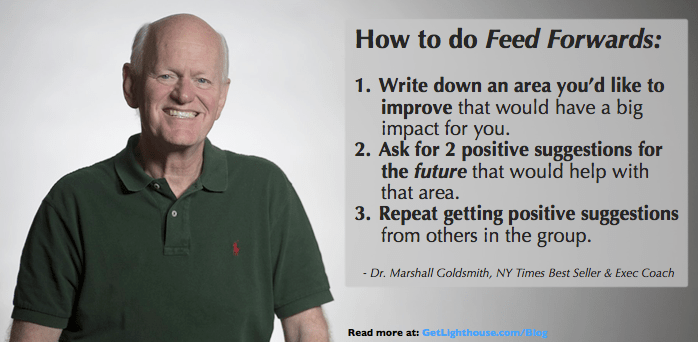
I was interested in this topic of feedback and its effect. I came across a very interesting concept from Marshall Goldsmith, he calls feedback as “feed forward.” The way “feed forward” works is by:
- Letting go of the past
- Listening to suggestions without judging
- Learning and Helping as much as you can

The way you engage with the person is important. In our last TILT meet-up Ian Faria mentioned that the feedback process needs to have these three things:
- The Intent to help,
- The Content to provide value
- The Context (situation/ timing) in which you are doing it. (For e.g. don’t offer negative feedback when the person has had a long, hard day)
The most important thing is to establish trust and also offer not more than two negative ones. For every negative feedback, give two or three positive ones as well.
As a giver of feedback please keep the “how” in mind. Don’t make a blunt statement. Soften your statement with “Diluters and Opinions.” The words “in my opinion” encourages the other person to listen and understand your position. The diluters are purely word choices “I think , I feel , If you don’t , You may want to consider” etc.
Today I noticed that my wife was boiling eggs. I asked her how much time it will take, she said ten more minutes and then forgot all about it. After some time, I heard a loud burst and saw her running. The egg had cracked and jumped out of the pan! I held myself not to offer any opinion and told her, “I feel (diluter) we should get an electric boiler as this process is dangerous.” Maybe a couple of years back I would have said “I told you” and our conversation would have gone in a different direction. Simple word choices and making adjustments to your facial expressions are very important for offering good feedback. My wife did not utter a word maybe she is following the maxim of “Defenceless is the best defence.”
A couple of weeks back I received feedback from around 25 people for a speech I gave in my club. It came as an avalanche and it was sweeping me off the stage. That is when I realised the importance of standing your ground, dropping your guard and embracing the ideas that will make you a better speaker. When you face any avalanche or hurricane, have a mindset of a learner and an ego that is antifragile. Dare to stare at your inadequacies and claim the power you get from outside. This will help you to become a better version of yourself everytime.
So next time if you are a giver or a receiver of feedback, be open and the only question which can help you “Dare to stare “is “Maye be there is some truth in it?”
